That sharp pain in your heel when you get out of bed? It’s not something you have to live with.
You wake up, put your feet on the floor, and suddenly feel a sharp, stabbing pain in your heel. Maybe it gets better after a few steps, only to return after a long day at work, walking around Queens, or standing on your feet for hours.
Sound familiar?
Heel pain can turn everyday moments into frustrating challenges. Walking to the subway, enjoying time with your family, exercising, or simply getting through your workday shouldn’t have to hurt.
The good news? You may not need surgery to find relief.
At the Queens podiatry practice of Dr. Louis P. Belcastro, we believe that getting you back on your feet starts with understanding your pain, your lifestyle, and what matters most to you.
Why Does My Heel Hurt So Much in the Morning?
One of the most common causes of heel pain is plantar fasciitis, a condition affecting the plantar fascia, the thick band of tissue connecting your heel to the front of your foot.
When this tissue becomes irritated or overloaded, it can cause pain, especially during those first steps in the morning or after sitting for an extended period.
You might notice:
- Sharp or stabbing pain underneath your heel.
- Discomfort when getting out of bed.
- Pain after prolonged standing or walking.
- Heel pain that improves temporarily with movement but returns later.
- Difficulty enjoying activities you once loved.
Heel spurs may also appear on X-rays, although they are not always the source of the pain.
Here’s what matters: persistent heel pain deserves attention. The sooner you understand what’s causing it, the sooner you can explore the right treatment options.
Tried Rest, Ice, or New Shoes but Still Have Heel Pain?
If you’ve already tried stretching, changing your shoes, using inserts, or taking pain medication without lasting improvement, you’re not alone.
Many people spend months adjusting their routines around heel pain, hoping it will eventually disappear.
But when discomfort continues, it may be time to consider a different approach.
That’s where Extracorporeal Shockwave Therapy (ESWT) may help.
What Is Shockwave Therapy, and Can It Really Help?
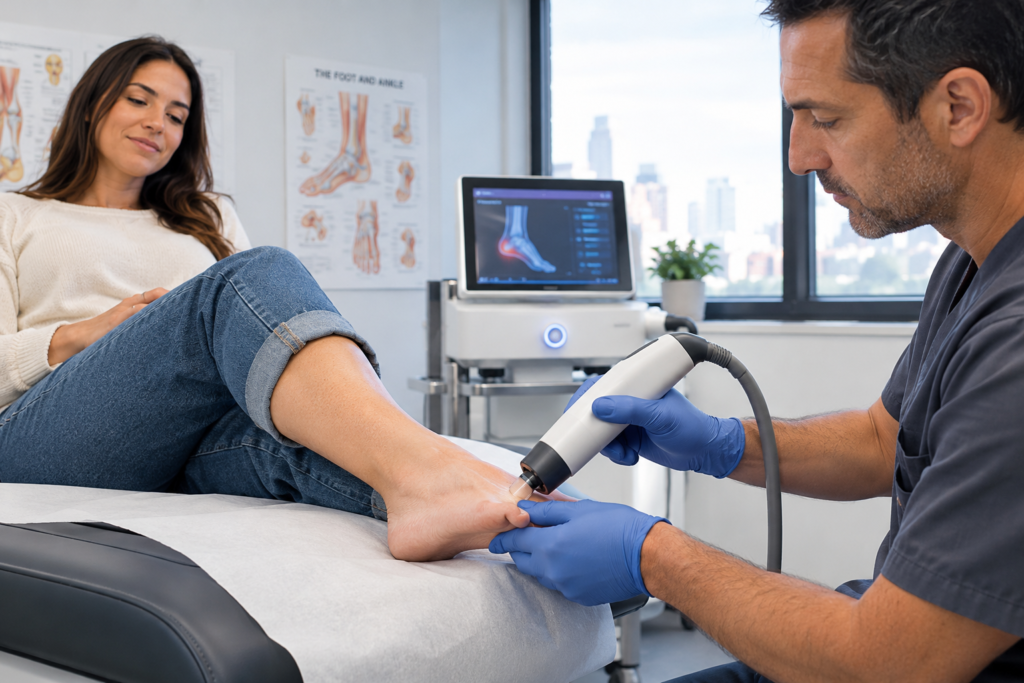
Extracorporeal Shockwave Therapy, commonly called ESWT, is an advanced, non-invasive treatment that uses acoustic pressure waves to stimulate the body’s natural healing responses.
For certain patients with chronic plantar fasciitis, ESWT may help reduce pain and improve mobility, particularly when initial conservative treatments haven’t provided enough relief.
Why patients are interested in ESWT
- No surgery: Treatment is performed without surgical incisions.
- No routine recovery downtime: Many patients can return to everyday activities shortly after treatment, with some temporary activity modifications.
- No needles required for the treatment itself: ESWT delivers acoustic waves externally.
- Supports natural healing: The therapy is designed to stimulate biological responses in the affected tissue.
- A potential option for stubborn heel pain: ESWT may benefit patients who haven’t improved with other non-surgical approaches.
Results vary from person to person, and improvement may develop gradually over several weeks. Not everyone is a candidate, which is why a thorough evaluation is essential.
More Than 24 Years of Experience. One Simple Philosophy: Treat the Person, Not the X-Ray.
For Dr. Louis P. Belcastro, treating heel pain is about more than identifying a medical condition.
It’s about understanding the person experiencing it.
Maybe you’re a parent who wants to enjoy walks with your children. A professional who spends long hours standing. Or someone who simply wants to get back to exercising without thinking about every step.
Your pain has a story. And your treatment should reflect it.
With more than 24 years of clinical experience, Dr. Belcastro combines medical expertise, advanced treatment options, and a personalized approach to foot and ankle care.
His philosophy is simple:
“Treat the person, not the X-ray.”
That means taking the time to listen, identify the underlying cause of your symptoms, and develop a treatment plan that fits your needs.
ESWT may be part of that plan, alongside stretching, supportive footwear, orthotics, rehabilitation, and other appropriate treatments.
The goal isn’t just to help you feel better temporarily. It’s to help you move more comfortably and reduce the likelihood of recurring problems.
Imagine Getting Back to Your Day Without Thinking About Heel Pain
Imagine waking up and taking those first steps without dreading the pain.
Walking through your neighborhood. Spending the day with your family. Getting back to your favorite activities.
For many patients, meaningful improvement is possible with the right diagnosis and treatment plan.
You don’t have to keep putting your life on hold while hoping your heel pain goes away.
Take the First Step Toward Feeling Better
If heel pain has been slowing you down, it may be time to explore your options.
Schedule a consultation with Dr. Louis P. Belcastro in Queens, NY, to discover what’s causing your discomfort and whether advanced, non-surgical treatments such as ESWT may be right for you.
Because your feet carry you through life. They deserve expert care.